







Home› News›Toy Safety for Under-Threes: Small Parts, Mag...
Toy Safety for Under-Threes: Small Parts, Magnets and Button Batteries
Three things cause nearly all the serious toy injuries in children under three, and none of them are the things parents worry about most. What the label on the box means, the toilet paper roll test, and what we do not sell and why.

Grandparents are coming, the gifts are already bought, and at least one of them has a label that says 3+ for a child who is fourteen months old. This is the article for that moment. It is short, because there are only three things that matter, and none of them are the things most parents worry about.
What the label actually means
A toy marked 3+ or "not for children under 3" is not saying the toy is too clever for a younger child. In the United States that warning is required when a toy contains small parts, and it means one thing: a piece of this toy could block a small airway. That is the whole message. A two-year-old is not held back by playing with a toy aimed at three-year-olds. A two-year-old is held back by a bead.
So read the label as a safety line, and use the age guide in toys by age for what a child will actually enjoy.
Risk one: small parts
The Consumer Product Safety Commission tests small parts with a cylinder about 1.25 in (3.2 cm) across. Anything that fits inside it entirely is a small part, and a toy for a child under three may not contain one, including after the toy has been dropped, bent and chewed.
At home, the cardboard tube from a roll of toilet paper is a decent stand-in. If a piece, or a piece that could break off, fits through the tube, it does not belong near a child who still puts things in their mouth. That covers most children well past two. It is why our toys for 0 to 12 months and toys for 1 year are chunky, and why a good busy board has nothing on it that comes off.
Risk two: loose magnets
One swallowed magnet usually passes. Two swallowed magnets, or a magnet and a piece of metal, can find each other through the wall of the intestine and pinch it shut, which is a surgical emergency and does not look like one from the outside. Toy magnets that can be released have to be weak enough not to do this, but the small, strong magnet sets sold for adults do not, and they are the ones that end up in emergency rooms.
For a child under three: magnets sealed inside a large piece, as in a magnetic puzzle or a magnetic maze, are fine. Loose magnets, magnet balls and building sets with small strong magnets are not, whatever the age on the box.
Risk three: button batteries
The flat coin-shaped battery in a musical toy, a light-up book or a remote control. Swallowed, it can start burning the throat within two hours, and the child may only seem to have a cold. Since 2023, products sold in the United States have had to keep these batteries behind a compartment that needs a tool or two separate movements to open. Older toys and cheap imports often do not.
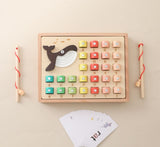
The rule at home: if a toy has a light or a sound, find the battery door and check it is screwed shut, the day it arrives and again after a month of use. If it is not, the toy goes up on a shelf. A few of our toys for this age have a light or a sound, a busy board with switches, a bath whale that glows, talking flashcards. The product page says so. Check the door on those too. We would rather you did than took anyone's word for it, including ours. See also what a baby under one actually does, which is mostly not pressing buttons.
The things that worry people more than they should
Wooden toys versus plastic: both are fine if the finish stays on and the piece is big enough. Paint: toys sold in the United States have to meet lead limits, so the question is whether the paint flakes, not what it is made of. Used toys: fine, after the same three checks and a wash. Noise: annoying, not dangerous, unless it is the kind you cannot turn off, in which case see risk three.
How we tag by age
Our age tags follow the small parts rule. Nothing tagged for 0 to 12 months, 1 year or 2 years should have a piece that fits through the tube, or a loose magnet. If you ever find one that does, tell us and we will fix the tag the same day. It keeps the under-three range smaller than it could be, and it means a few popular things are missing from it. We would rather explain that than ship them.
The short version
- 3+ is a small parts warning, not an intelligence rating.
- If it fits through a toilet paper roll, it is a small part.
- No loose magnets. One is a scare, two is surgery.
- Lights and sounds mean a battery. Find the door, check the screw.
Everything in our toy collection is tagged by age with these three rules first and the fun second, and the puzzle guide shows how that works in practice.
General information, not medical advice. If a child has swallowed a magnet or a battery, or you think they might have, go to the emergency room now and do not wait for symptoms.