



Home› News›Sensory Toys for a Baby Under One: What Senso...
Sensory Toys for a Baby Under One: What Sensory Actually Means
It is on half the baby toys sold and it is not a standard. What a baby under one actually does with a toy, the three things that are enough, and what is simply too early.

Pick up any baby toy and the word is on the box. Sensory ball, sensory blanket, sensory kit. It sounds like a standard, like a test the toy passed. It is not. It is a description of what every baby toy does anyway, because for the first year a baby's whole job is to put the world through their senses, one object at a time.
So the word tells you nothing. What the baby does with the toy tells you everything.
What a baby under one actually does
Looks, for the first three months. Contrast, slow movement, your face. A black and white card does as much as anything you can buy, and most of it is done by the window and the ceiling fan.
Grabs, from about three months. The fists open and the reaching starts. Anything grabbed goes to the mouth. Not sometimes. Always.
Mouths, from four months to well past the first birthday. The mouth is the most sensitive part of a baby, and chewing a thing is how they learn what it is. A toy for this age is a toy that will be chewed, dribbled on and chewed again.
Drops, bangs and empties, from about seven months. Once a baby sits, both hands are free. Things get banged together, dropped off the high chair on purpose, and taken out of a box and put back in. This looks like chaos and is the most serious work of the year.
The three things that are enough
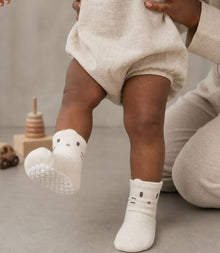
Something to grab and chew. A rattle light enough for a small hand, with a shape that is easy to hold and safe to bite. Fabric wrist and sock rattles work early because the baby does not have to hold them at all. The animal rattle set is that kind.
Something to stack and empty. Cups that nest inside each other and stack on top. They get filled, emptied, chewed, banged, used in the bath and lost under the sofa, and they cost almost nothing. If you buy one toy for the second half of the first year, buy stacking cups.
Something with texture. Ribbons, crinkle, a flap that lifts, a surface that is bumpy next to one that is smooth. A soft activity box covers this in one object. So does a towel and a wooden spoon, and we would rather say that than sell you a fourth thing.
What is too early
Busy boards, for the first ten months: the hands cannot do a latch yet. See busy boards: which age. Puzzles, until well after the first birthday. Anything with small pieces, batteries or lights, which do the playing for the baby and add a risk for no return. The reasons are in toy safety for under-threes.
Too many toys at once is also too early. A baby with three things in reach plays with them. A baby with fifteen looks at the ceiling.
Since everything goes in the mouth
Buy for the mouth. Silicone, untreated wood, cotton. No paint that flakes, no seams that split, no pieces smaller than a toilet paper roll. Wash what can be washed, and throw away a teether or rattle that has a crack, because a crack is where the mould lives. The same rule runs through bath toys, where a hole that fills with water is a hole that goes black inside.
The short version
- Sensory is a description of every baby toy, not a standard. Ignore the word.
- Three things cover the first year: something to chew, something to stack, something with texture.
- Everything goes in the mouth, so buy for the mouth.
- Fewer toys in reach, more play.
Our baby and sensory toys are chosen with the mouth in mind, and toys for 0 to 12 months is the whole first year on one page. For what comes after, start with toys by age.