




Home› News›Learning Toys vs Workbooks: What a Four-Year-...
Learning Toys vs Workbooks: What a Four-Year-Old Needs Before Kindergarten
Letters come quickly once the hands are ready, and hands get ready through play. What kindergarten actually asks for, which learning toys do real work, and when a workbook makes sense.

The kindergarten registration form arrives in spring, and somewhere on it is a line like "Can your child write their first name?" Yours is four, holds a crayon in a fist, and draws a sun with legs. Suddenly the workbook aisle looks like the answer.
Usually it is not. Letters come quickly once the hands are ready, and hands get ready through play.
Hands first, letters second
Most children copy a circle around three, a cross around four, and a square somewhere between four and five. Letters with slanted lines, like A, K and M, need the diagonal, which usually comes after the square. A child who cannot do that yet is not behind. The hands are on an earlier step.
Squeezing play dough, threading beads, tearing paper, drawing. That is the practice for writing. It started with the latches on a busy board at one, and it has not stopped.
What kindergarten actually asks for
Most readiness lists are short, and mostly about independence and hands:
- Opens a lunch box and a water bottle without help.
- Holds a crayon with the fingers, not a fist, most of the time.
- Recognizes their own name when they see it.
- Sits through a short story and waits for a turn.
- Counts a handful of things, touching each one once.
None of it needs a workbook.
Learning toys that do real work
A good learning toy makes the child do the thinking. Three kinds cover most of it.
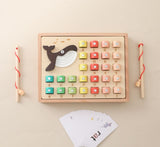
Something to count with. A wooden counting board turns "two and three" into something you can see and touch.
Something to match. Letter cards that pair with a picture. Matching comes before reading.
Something to build or solve. Puzzles and building toys train the same hands. If a framed jigsaw is still hard, the order in puzzles for a two-year-old still applies.
What is just noise
The word educational on the box. It is not a standard. Look at what the child does with the toy, not at the label.
Toys that say the answer. A tablet that names the letter when it is pressed is fine in the car. At home it does the part of the work that matters, so keep it as an extra, not the main thing.
Speed drills. A child who can name thirty flash cards in a row has learned thirty cards. Counting real spoons onto a real table is counting.
Buying to get ahead. Kindergarten is built to teach letters and numbers from the start. Before then, the list above is the job, not the curriculum.
One more thing if there is a younger sibling: magnetic letters and small counters are made for children past the mouthing stage. Why that matters is in toy safety for under-threes.
When a workbook makes sense
When the child asks for one. Some four-year-olds love a page and a pencil the way others love a puzzle, and that is fine. A few rules keep it that way:
- Lines and mazes before letters. Tracing a road from the car to the house is pen control, and it comes before an A.
- Pages that wipe clean take the fear out of a wrong line. Reusable tracing books with dry erase markers are that kind.
- Ten minutes is a good session. Stop while it is still fun.
- A short, thick crayon is easier for small fingers than a long pencil.
If it turns into tears, put it away for a month. Nothing is lost, and it often comes back easier.
The short version
- Hands come before letters. Squeezing, threading and drawing are the practice for writing.
- Kindergarten readiness is mostly independence: lunch box, own name, waiting a turn.
- A good learning toy makes the child think. A toy that says the answer does not.
- A workbook is fine when the child asks, for ten minutes, starting with lines.
Our learning and early school shelf is tagged by age, so toys for 4 years shows only what fits now. For every other stage, start with toys by age.