





Home› News›Puzzles for a Two-Year-Old: Knob, Peg or Jigsaw?
Puzzles for a Two-Year-Old: Knob, Peg or Jigsaw?
A puzzle that is too hard is not a challenge, it is a toy that gets thrown. The order that works from one to three, how to tell when it is time for the next step, and the building toys that belong alongside.

You bought a twelve piece jigsaw because the box said 2+, and your two-year-old tipped it out, chewed one piece, and walked off. That is not a child who does not like puzzles. That is a puzzle three steps ahead of the hands doing it.
Puzzles have an order. Get the order right and a child will sit with one for twenty minutes. Get it wrong and it goes under the sofa.
Step one, around the first birthday: the knob puzzle
Three or four big pieces, each with a fat knob on top, each fitting one obvious hole. The job is not the picture. The job is grabbing the knob, lifting the piece out, and getting it back in roughly the right place. That is a whole skill for a one-year-old, and it takes months.
Look for pieces that are chunky enough not to fit through a toilet paper roll, because at this age the piece goes in the mouth first and the hole second. More on that in toy safety for under-threes.
Step two, around two: peg and shape puzzles
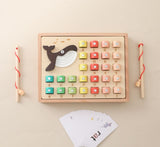
Now the knob shrinks to a small peg, or disappears, and the number of pieces goes up to six or eight. The child has to turn a piece to make it fit, which is new, and has to match a shape to its outline, which is the first real thinking. A wooden shape puzzle is exactly this stage: a shape, an outline, and nothing that needs to be read yet.
Shape sorters belong here too. They are a puzzle turned into a box, and the same rule applies: three or four shapes first, not twelve. A garden shape sorter is the simple kind.
Step three, around three: the first jigsaw
Four to twelve pieces that lock into each other inside a frame. The frame matters: a tray with a picture underneath is a jigsaw with the answer printed on it, and that is what a three-year-old needs. The loose jigsaw in a box, with no frame and no picture to lean on, is a four-year-old's puzzle however few pieces it has.
A magnetic story puzzle is a gentle way into this. The pieces stick where they are put, so a nearly right answer stays on the board instead of sliding off the table.
How to tell it is time for the next step
The puzzle gets done fast, then done again, then done upside down for fun. That is mastery, and it is the signal. Not boredom with puzzles, boredom with this puzzle. Move one step up, not three. If the new one gets thrown, you went too far, and the old one goes back on the shelf for another month without anyone losing face.
Building toys are puzzles without a right answer
Blocks, stacking towers and magnetic figures live on the same shelf as puzzles for a reason. They train the same hands, but there is no wrong way to do them, which makes them the thing to reach for on a day when the puzzle is frustrating. A set of soft building blocks gets chewed at six months, stacked at one and sorted by color at two, which is three toys for the price of one.
If your child is still in the latch and zipper phase, a busy board comes before any of this.
What to skip
Puzzles with sound, which do the thinking for the child. Puzzles with more pieces than the age can manage, bought to grow into: a puzzle is not a shoe, and there is no growing room in it. Puzzles with pieces small enough to swallow for any child who still mouths things, which is most two-year-olds.
The short version
- Knob puzzle at one, peg and shape at two, framed jigsaw of 4 to 12 pieces at three.
- Mastery is the signal to move up. Move one step, not three.
- Blocks and stacking toys are the no-wrong-answer version. Keep both on the shelf.
- No sound, no growing into it, no small pieces while things still go in the mouth.
Our puzzles and building toys are tagged by age, so toys for 2 years shows only the peg and shape step. The full age map is in toys by age.